

Ticket Information
On Sale Dates:
VIP Members: Tue, Aug 18, 2026
Supporting Members: Tue, Sep 1, 2026
General Public: Tue, Sep 15, 2026
Become a member, see the package here
For enquiries, please email nyuad.boxoffice@nyu.edu.
Two Gulf premieres including an Arts Center co-commission
Contemporary dance meets visual art installation
Sat-Sun, May 22-23 @ 7:30pm, 2027
The Black Box, The Arts Center
The evening features:
Knot - dance meets sculptural installation.
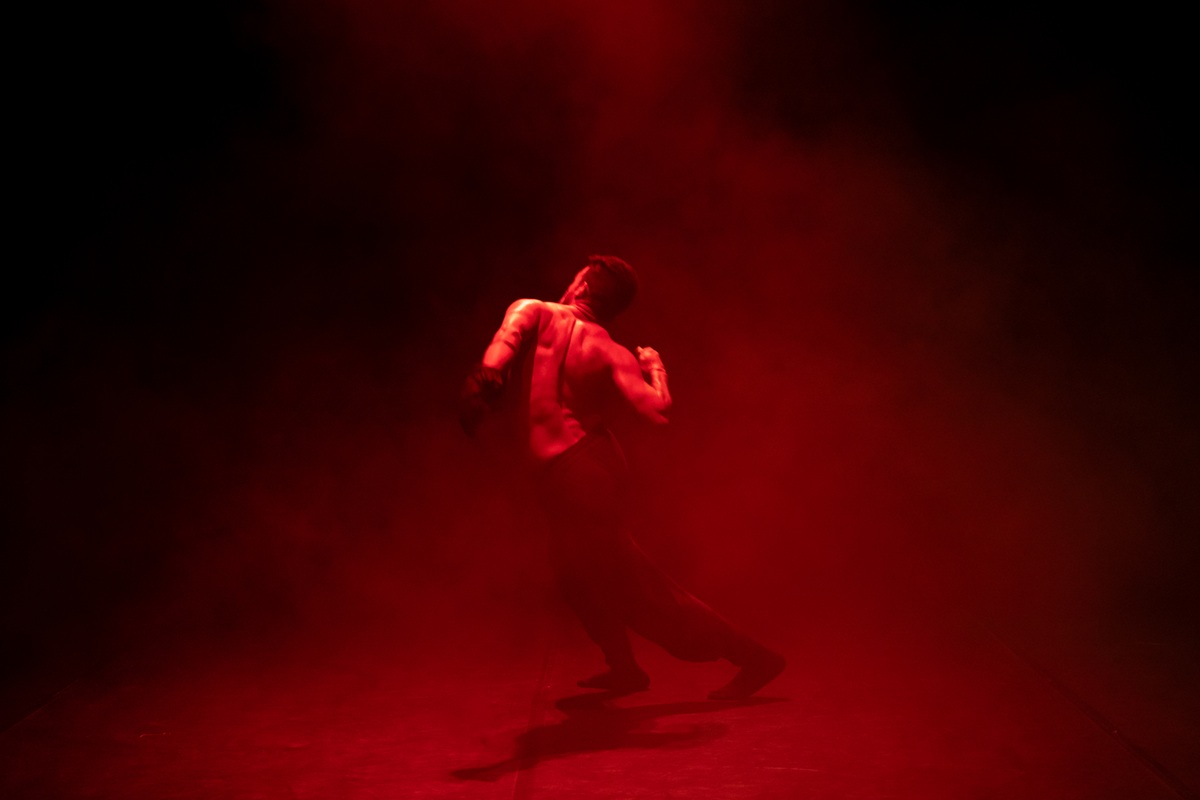
Just One Tile - vibrant, rebellious solo merges Mahraganat with contemporary dance.
Knot - Afra Al Dhaheri & Dovydas Stramaitis
Co-commissioned by The Arts Center, Knot is a dance solo that unfolds at the intersection of dance and visual installation. It’s situated within a sculptural installation where hair extends into rope – shifting from intimate bodily material into architectural structure. Long extensions stream from the performer’s head, transforming gradually into rope that anchors onto the ceiling and surrounding space. This rope-hair continuum forms a monumental web in which the performer is physically entangled. She is sustained by the structure, restricted by it, and inseparable from it.
In Knot, the rope is not a passive scenography, but an active choreographic force that shapes gesture, limits it, expands it, and defines it. Through this interdependence of body and material, Knot dissolves boundaries between subject and environment, and choreography and sculpture – the performer does not perform inside the space, she becomes the space.
Rooted in Al Dhaheri and Strimaitis’s ongoing exploration of hair, Knot posits it as a site where nature and culture collide. But here, this collision evolves into transformation. Hair becomes rope. Body becomes structure. Craft becomes architecture. This continuum is where identity is negotiated: not fixed, but constantly mediated between internal forces and external systems. A complex medium and a polysemic element through which the body expresses and resists, the hair anchors the piece conceptually and visually, intertwining personal narrative and collective history.
Just One Tile - Islam Elarabi
Just One Tile is a solo performance by Egyptian dancer and choreographer Islam Elarabi that merges Mahraganat with contemporary dance to embody emotions of power, pride, fear, anger, and joy. The work draws on Elarabi’s lived experience and collective memory, transforming the pulse of Egyptian street culture into a profound stage language. Rooted in Mahraganat — the vibrant, rebellious music and dance born from Cairo’s streets — the piece reclaims a cultural expression often dismissed as “non-art.” Through Just One Tile, Elarabi challenges such perceptions, affirming Mahraganat as a legitimate, contemporary art form that carries social, political, and emotional depth. The performance unfolds as an act of resistance and self-assertion, reclaiming visibility for a community that continues to be misrepresented or overlooked.
Elarabi’s movement language builds from a locally grounded practice, creating his own autonomous artistic vocabulary. With minimal elements, he crafts vivid imagery that reflects both exhaustion and liberation. The work embodies “a choreography of struggle and release,” as described by the ZKB Jury, recognizing the artist’s ability to transform personal material into a powerful, poetic expression of resilience.
In Just One Tile, a single floor tile becomes a metaphor for space, identity, and survival. As PS Zeitung noted, Elarabi “crouches on the smallest surface, fists raised to shield himself from a symbolic guillotine... His dance unites the imagined heroic self-image of victorious resistance with the fragility of surrender.” The performance evokes the spirit of Cairo’s Tahrir Square—a collective yearning for freedom—while balancing immense physical power with poetic sensitivity. Through light, sound, and embodied rhythm, Mahraganat becomes the sound of rebellion, carrying the urgency and hope of those who continue to dance despite constraint.
First presented as a work-in-progress at the UN|Controlled Gestures Residency in Cairo and Berlin, Just One Tile continues to evolve as an intimate yet universal portrait of struggle, resistance, and belonging.
International Short Films Program
Curated by Nawaf Al Janahi
Tue, Oct 20 @ 7:30pm, 2026
The UAE National Orchestra presents
Rossini • Mendelssohn • Brahms
Thu, Oct 22, 2026 7:30 pm. Doors Open: 7:00 pm
UAE Premiere
Presented with the support of Dance Reflections by Van Cleef and Arpels
Fri, Oct 30 @ 7:30pm, 2026


